Hydraulic Cylinders for Cold Drawing Machines: 10 Key Engineering Considerations
Cold drawing is a widely used metalworking process for producing tubes, bars, and profiles with improved dimensional accuracy and surface quality.
In heavy-duty cold drawing equipment, hydraulic systems can provide the controlled movement and high pulling forces required for processing metal workpieces. The hydraulic cylinders used in these machines must often operate under demanding conditions involving substantial axial loads, long working strokes, and repeated production cycles.
For equipment manufacturers, selecting the appropriate hydraulic cylinder is essential to machine performance, reliability, and long-term maintenance.
This article explores how hydraulic cylinders are used in cold drawing machines and the most important factors to consider when specifying custom cylinders for industrial drawing applications.
1. What Is a Cold Drawing Machine?
A cold drawing machine is used to reduce or modify the cross-section of metal products by pulling them through a forming die, generally without heating the workpiece to hot-working temperatures.
Common materials processed through cold drawing include carbon steel, alloy steel, stainless steel, copper, and aluminum.
Depending on the workpiece and tooling arrangement, cold drawing can help achieve:
Improved dimensional accuracy
Better surface finish
Controlled cross-sectional geometry
Increased strength through work hardening
Consistent dimensions for subsequent machining or manufacturing
Cold drawing equipment is widely used in the production of precision tubes, steel bars, mechanical components, and industrial profiles.
Different machine designs use different driving mechanisms, including chain-driven, mechanically driven, and hydraulically driven draw benches.
In a hydraulic draw bench, the main hydraulic cylinders may provide the linear movement and pulling force required for the drawing operation.
However, not every cold drawing machine uses a hydraulic cylinder as its main drawing actuator. Some machines use hydraulic cylinders only for clamping, feeding, pointing, positioning, or other auxiliary functions.
Understanding the actual machine configuration is therefore essential before selecting a cylinder.
2. How Do Hydraulic Cylinders Work in a Cold Drawing Machine?
A typical hydraulic cold drawing system includes a drawing die, a drawing carriage, a workpiece gripping mechanism, a hydraulic power unit, and one or more hydraulic cylinders.
During the drawing process, the workpiece is gripped and pulled through the die, where its cross-sectional geometry is changed through plastic deformation.
In machines with hydraulic main drives, cylinder movement generates or transmits the required drawing force through the carriage or associated mechanical structure.
Depending on the equipment design, the main cylinder may perform the drawing stroke through extension or retraction.
This distinction is important because a conventional single-rod hydraulic cylinder generates different theoretical forces on its extension and retraction strokes.
The cylinder configuration must therefore be selected according to the actual direction of loading and the machine's mechanical arrangement.
Hydraulic cylinders may also be used elsewhere in the machine for operations such as:
Workpiece clamping: Securing the tube or bar during drawing.
Carriage positioning: Moving or positioning mechanical assemblies before and after a drawing cycle.
Die or tooling adjustment: Positioning selected tooling components where hydraulic actuation is appropriate.
Auxiliary handling: Operating supporting mechanisms for feeding, transfer, or unloading.
Each function may require a different cylinder size, stroke, pressure rating, and mounting arrangement.
3. Drawing Force: The First Critical Parameter
The required drawing force depends on the material and the specific forming process.
Important factors include:
Workpiece material and mechanical properties
Initial and final cross-sectional dimensions
Percentage reduction per drawing pass
Drawing die geometry
Lubrication and friction conditions
Drawing speed and process conditions
Tooling and mandrel arrangement, where applicable
For hydraulic cylinder selection, the required drawing force should be established from process engineering calculations, machine design data, or validated operating measurements.
The basic theoretical hydraulic force equation is:
F = P × A
Where:
F = Theoretical hydraulic force
P = Hydraulic pressure
A = Effective piston area
For conventional single-rod cylinders, the available theoretical force depends on whether the hydraulic cylinder is extending or retracting.
When calculating actual cylinder force, the pressures acting on both piston faces must be considered. Mechanical friction and other system losses must also be included in the engineering assessment.
For machines using multiple main cylinders, the load distribution between cylinders is another important consideration.
The combined theoretical force alone does not guarantee uniform loading.
Structural stiffness, alignment, synchronization, and the mechanical arrangement of the drawing carriage can influence how the total load is shared.
4. Why Long Stroke Length Creates Additional Design Challenges
Cold drawing equipment often requires considerable travel distance to accommodate long workpieces.
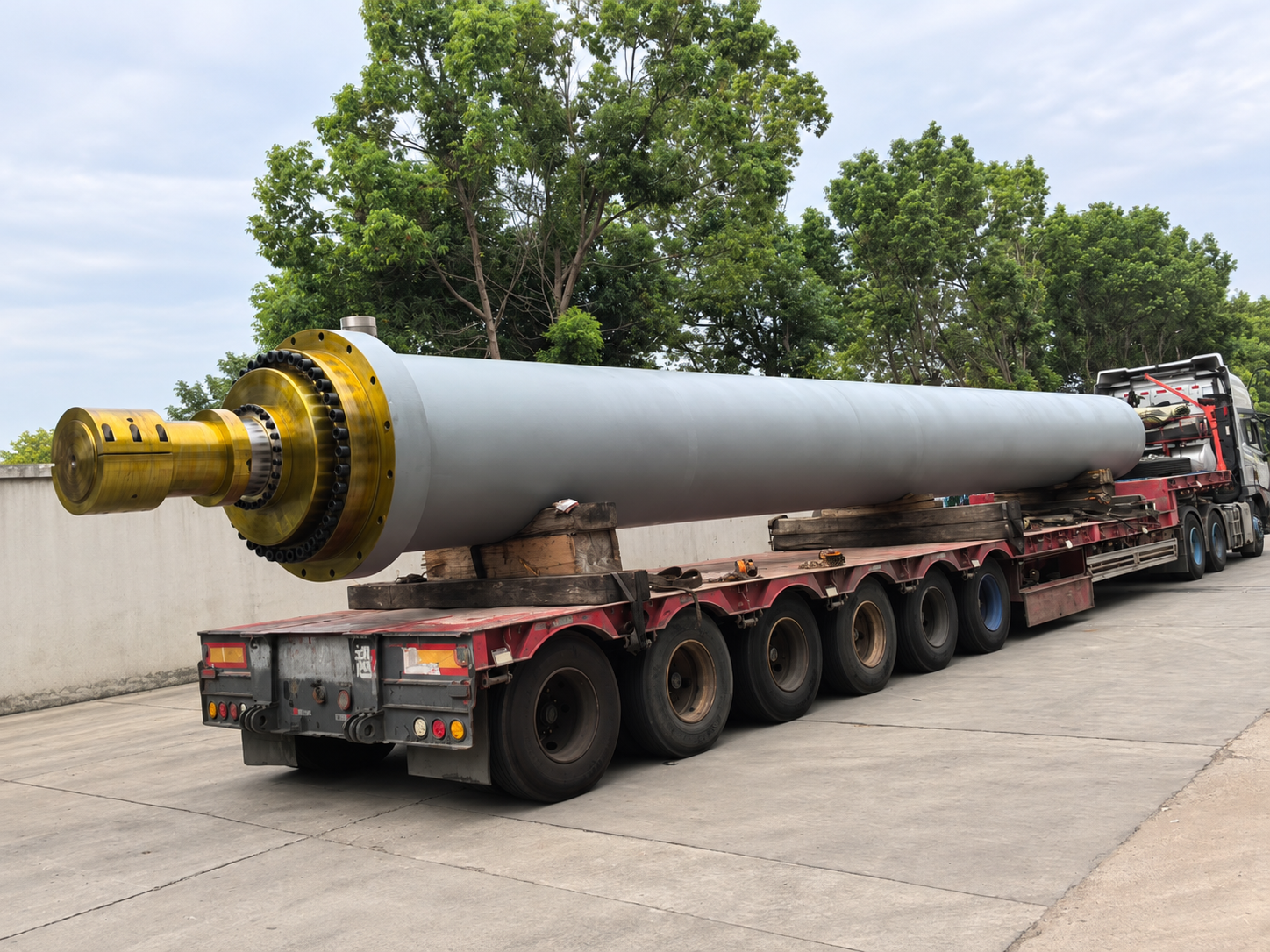
As a result, hydraulic cylinders used in certain drawing machines may require unusually long strokes compared with standard industrial cylinders.
Long-stroke cylinder design introduces several important engineering challenges.
Piston Rod Stability
When the piston rod is subjected to compression, excessive unsupported length can increase the risk of buckling.
Rod diameter, effective length, mounting conditions, and maximum compressive load must be reviewed carefully.
For pulling applications where the rod is primarily in tension, tensile strength and connection integrity are important. Compression and stability checks may still be required for return strokes or other operating conditions.
Cylinder Alignment
Long cylinders are particularly sensitive to installation alignment.
Poor alignment can generate unwanted side loads, which may accelerate wear on rod bearings, seals, and guide components.
The machine structure should provide adequate guidance to ensure that the drawing load is transferred as intended.
Manufacturing Accuracy
Long cylinder barrels and piston rods can be challenging to machine.
Important considerations include straightness, dimensional tolerances, concentricity, and the required surface finish.
These requirements should be defined according to the final design and application rather than assumed from general manufacturing standards.
Installation and Maintenance
Long hydraulic cylinders also require careful planning for transportation, installation, inspection, and maintenance.
The extended and retracted overall lengths, mounting interfaces, and available removal space should be considered during equipment design.
5. Selecting the Right Hydraulic Cylinder Configuration
There is no single cylinder configuration suitable for every cold drawing machine.
The most appropriate solution depends on the driving arrangement, available space, loading direction, and overall machine design.
For example, a double-acting cylinder can provide hydraulically controlled movement in both directions.
A machine may use a single large main cylinder or multiple cylinders arranged to drive a common carriage.
Alternative arrangements may be selected to accommodate specific space constraints or mechanical requirements.
Engineers should consider the following when choosing a configuration:
Drawing direction: Whether the main drawing load acts during cylinder extension or retraction.
Load requirements: Maximum force under the most demanding operating conditions.
Available installation space: Cylinder overall length, mounting position, and clearance.
Speed requirements: Required drawing speed and return speed.
Structural integration: How the hydraulic force is transferred through the machine frame and drawing carriage.
Maintenance access: Ease of inspection, seal replacement, and eventual cylinder removal.
The selection should be based on the complete mechanical and hydraulic system rather than the cylinder dimensions alone.
6. Hydraulic Flow, Drawing Speed, and Production Efficiency
Hydraulic cylinder speed is related to volumetric flow rate and effective hydraulic area.
For an idealized cylinder movement:
v = Q / A
Where:
v = Piston velocity
Q = Volumetric flow rate
A = Effective piston area
For a given flow rate, a larger effective piston area produces a lower theoretical piston speed.
This means that increasing cylinder bore diameter to obtain more force may also increase the hydraulic flow required to maintain the desired drawing speed.
Equipment manufacturers must therefore consider the relationship between drawing force, working pressure, hydraulic flow, and cycle time.
For many draw bench applications, it is also important to distinguish between the controlled drawing stroke and the return stroke.
The machine may require different speed characteristics during these operations.
Appropriate hydraulic controls, flow capacity, and motion management can help meet production requirements while maintaining stable machine operation.
7. Wear, Sealing, and Reliability in Repeated Drawing Operations
Cold drawing equipment may operate through repeated production cycles, creating demanding conditions for hydraulic components.
Over time, cylinder reliability can be affected by:
Repeated pressure cycles
Contamination in hydraulic fluid
Seal friction and wear
Rod surface damage
Misalignment and excessive side loading
Temperature variations
Improper installation or maintenance
For custom hydraulic cylinders, seal selection should reflect the operating pressure, temperature, hydraulic fluid, speed, and expected duty cycle.
Piston rod surface treatment should also be selected according to the application environment and wear requirements.
In industrial environments, effective filtration, suitable fluid maintenance, and appropriate protection against contamination can contribute to reliable operation.
A well-designed cylinder should also allow practical access to components that may need servicing during the machine's operating life.
8. Why Custom Manufacturing Matters for Heavy-Duty Draw Benches
Standard hydraulic cylinders are suitable for many industrial applications.
However, specialized cold drawing equipment may require cylinder dimensions or connection arrangements that are not available in standard product ranges.
Custom manufacturing allows the cylinder to be adapted to the specific equipment design.
Typical customization requirements may include:
Non-standard bore and piston rod diameters
Long working strokes
Project-specific overall dimensions
Custom flange or pin mounting interfaces
Special piston rod end connections
Material and coating specifications
Application-specific sealing arrangements
Agreed inspection and testing requirements
For replacement or equipment-upgrade projects, manufacturers may also need to reproduce an existing cylinder according to technical drawings or verified measurements.
This makes drawing-based manufacturing particularly relevant to specialized heavy industrial machinery.
9. What Should OEMs Provide When Requesting a Custom Cylinder?
Clear technical specifications allow the cylinder manufacturer to evaluate feasibility and prepare a more accurate quotation.
The following information is particularly useful:
Specification | Details |
|---|---|
Machine application | Tube, bar, or profile drawing |
Required drawing force | Maximum force and load conditions |
Cylinder function | Main drive, clamping, positioning, or auxiliary use |
Working pressure | Normal and maximum operating pressure |
Bore diameter | Required dimension or preliminary design target |
Rod diameter | Required dimension or preliminary design target |
Stroke length | Required working travel |
Loading direction | Extension, retraction, or both |
Mounting arrangement | Flange, pin, or other interface |
Operating cycle | Drawing speed, return speed, and duty cycle |
Materials and coating | Required grades and surface specifications |
Quantity | Prototype, replacement, or production order |
Drawings | Assembly and component drawings, if available |
Inspection and testing | Applicable standards and acceptance requirements |
When detailed drawings are available, they are especially valuable for confirming manufacturing feasibility, material requirements, critical dimensions, and production processes.
For particularly large cylinders, transportation dimensions and installation constraints should also be discussed early.
10. Custom Hydraulic Cylinders for Cold Drawing Machines at Juding
Juding Heavy Industry (Jiangsu) Co., Ltd. is a hydraulic cylinder manufacturer based in Wuxi, China, specializing in custom heavy-duty hydraulic cylinders and precision cylinder components.
Our manufacturing scope includes large-bore and long-stroke hydraulic cylinders built according to customer drawings and technical specifications.
Our production capabilities include large-scale CNC turning, deep-hole boring, honing, piston rod machining, welding, assembly, and hydraulic testing.
Juding supports applications involving heavy industrial equipment, including hydraulic presses and cold drawing machinery.
For OEMs and equipment manufacturers developing specialized drawing machines, we can review custom cylinder manufacturing requirements based on supplied drawings and specifications.
Frequently Asked Questions
What is the difference between a hydraulic draw bench and a chain-driven draw bench?
The main difference is the driving mechanism used to generate drawing movement. A hydraulically driven draw bench uses hydraulic actuation for the main drawing operation, while a chain-driven machine uses a mechanical chain drive. Some machines combine mechanical drives with hydraulic auxiliary systems.
Do cold drawing machines always require long-stroke cylinders?
Stroke requirements depend on the machine configuration, workpiece length, and cylinder function. Some machines require long-stroke main cylinders, while others use shorter cylinders only for clamping or positioning.
Can one hydraulic cylinder provide the full drawing force?
It depends on the cylinder design and machine arrangement. Some machines use a single main cylinder, while others use multiple cylinders. Structural loading, alignment, synchronization, and available space must be evaluated.
Can a cold drawing machine cylinder be manufactured from an existing drawing?
Yes. Where suitable technical drawings and specifications are available, a custom manufacturer can evaluate whether the cylinder can be produced according to those requirements.
Can a custom hydraulic cylinder be manufactured for an existing draw bench?
Yes, subject to technical review. Replacement projects typically require confirmation of mounting dimensions, bore and rod sizes, stroke, pressure rating, operating conditions, and interface requirements.
Looking for Custom Hydraulic Cylinders for a Cold Drawing Machine?
Juding Heavy Industry specializes in manufacturing large-bore, long-stroke, and non-standard hydraulic cylinders for heavy industrial applications.
Whether you are developing a new hydraulic draw bench, upgrading existing equipment, or sourcing replacement cylinders, our team welcomes drawing-based manufacturing inquiries.
Send us your hydraulic cylinder drawings or technical specifications for manufacturing feasibility review and quotation.
Juding Heavy Industry (Jiangsu) Co., Ltd.
Email: juding@judingindustries.com
Website: https://judingindustries.com/
Contact us to discuss your custom hydraulic cylinder requirements.