Resource
Large-Bore Hydraulic Cylinders for Industrial Presses: A Practical Specification Guide
9 Key Engineering Considerations for Large-Bore Hydraulic Cylinders in Heavy-Duty Presses
Large-bore hydraulic cylinders are essential components in heavy-duty industrial presses, where extremely high forces must be generated and controlled reliably.
They are commonly used in forging presses, metal forming presses, extrusion equipment, and other high-load industrial machinery. Unlike standard hydraulic cylinders, these applications often require customized dimensions, robust structural designs, and carefully controlled manufacturing processes.
For equipment manufacturers and engineering teams, selecting a large-bore hydraulic cylinder involves much more than choosing a bore diameter and operating pressure.
This guide explains nine important engineering considerations when specifying custom hydraulic cylinders for heavy-duty press applications.
1. Determine the Required Pressing Force
The first step is to establish the actual force required by the press.
The theoretical hydraulic force generated by a cylinder is calculated as:
F = P × A
Where:
F = Theoretical hydraulic force (N)
P = Pressure acting on the effective piston area (Pa)
A = Effective hydraulic area (m²)
For a conventional single-rod cylinder, the full piston area is:
A = πD² / 4
Where D is the cylinder bore diameter.
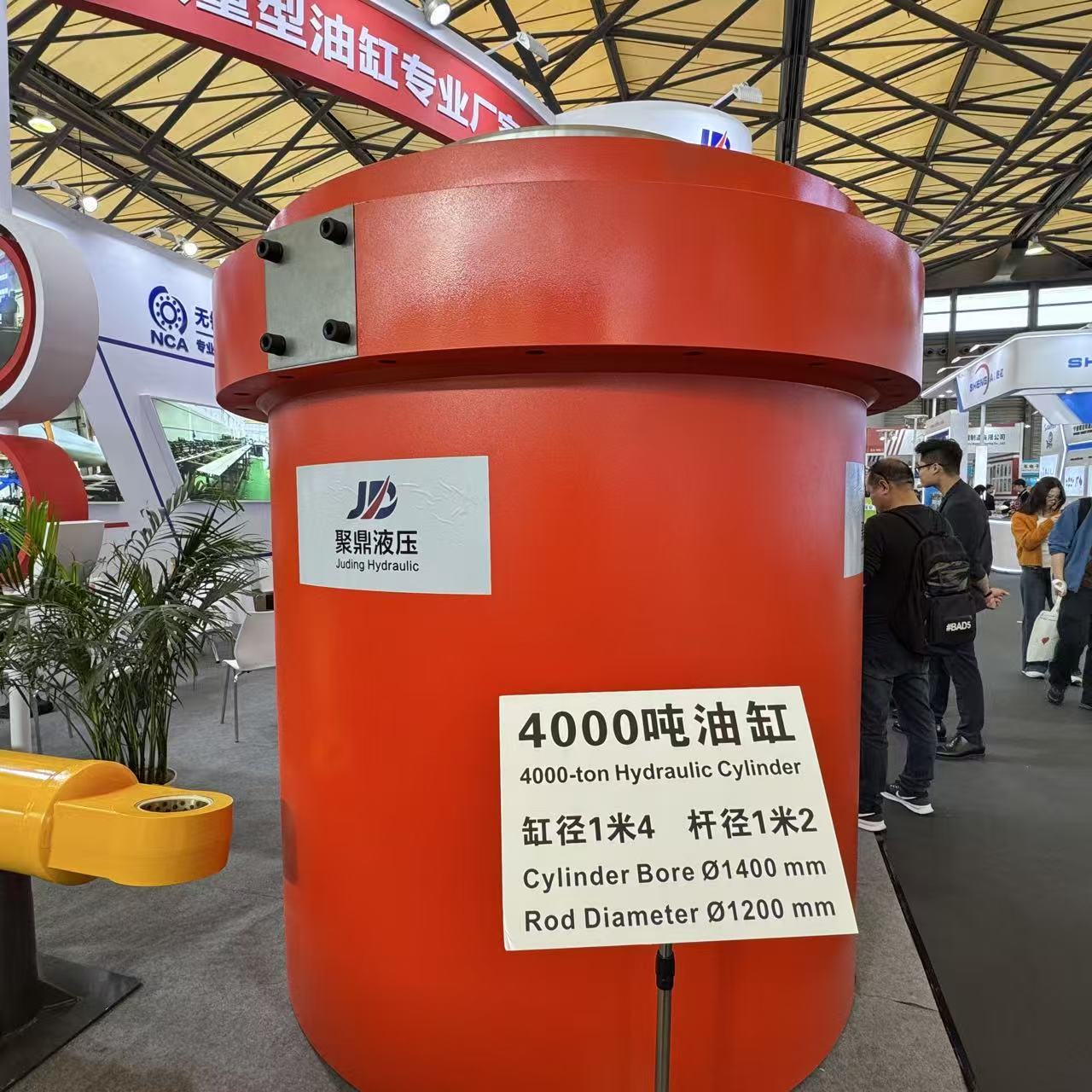
Example: A 1,400 mm Bore Hydraulic Cylinder
Consider a hydraulic cylinder with:
Cylinder bore: 1,400 mm
Operating pressure: 25 MPa (250 bar)
Full piston area: Approximately 1.539 m²
The theoretical extension force, assuming pressure acts on the full piston area with no opposing rod-side pressure, is:
F = 25,000,000 × 1.53938
F ≈ 38.48 MN ≈ 3,924 metric tonnes-force
This example demonstrates how a large-bore hydraulic cylinder can generate forces approaching 4,000 tonnes-force.
However, this value represents the theoretical hydraulic force, not necessarily the usable pressing force delivered by the machine.
Actual available force depends on opposing chamber pressure, friction, pressure losses, mechanical geometry, and other operating conditions.
For presses using multiple cylinders, the overall pressing force also depends on the arrangement and loading of the complete system.
2. Specify Operating Pressure and Peak Pressure
Operating pressure is one of the most important parameters influencing cylinder design.
Higher hydraulic pressure can generate more force from the same bore diameter. However, it also increases the demands placed on pressure-retaining components, seals, connections, and structural design.
When preparing a specification, manufacturers should distinguish between:
Normal working pressure
Maximum operating pressure
Temporary pressure peaks
Required proof or acceptance test pressure
The design must consider the applicable pressure and load cases rather than relying only on the nominal system pressure.
For custom heavy-duty cylinders, pressure requirements should be reviewed alongside material strength, cylinder barrel wall thickness, end-cap connections, fatigue loading, and relevant design standards.
3. Select the Bore and Piston Rod Dimensions
Cylinder bore diameter largely determines the available theoretical hydraulic force, while piston rod diameter influences structural strength, stiffness, stability, and retraction force.
For a conventional double-acting, single-rod cylinder, the effective rod-side area is:
Aᵣ = π(D² − d²) / 4
Where:
D = Cylinder bore diameter
d = Piston rod diameter
For example, consider:
Bore diameter: 1,400 mm
Piston rod diameter: 1,200 mm
Rod-side pressure: 25 MPa
The effective rod-side area is approximately 0.408 m².
The theoretical retraction force is therefore approximately:
10.21 MN, equivalent to 1,041 metric tonnes-force.
This is significantly lower than the theoretical extension force because the piston rod reduces the hydraulic area on the rod side.
These values are illustrative engineering calculations, not performance ratings of a specific Juding product.
For every project, the final bore and rod combination must be checked against the actual loading conditions, cylinder configuration, and structural requirements.
4. Confirm Stroke Length and Installation Dimensions
Stroke length determines the distance the piston can travel between its specified end positions.
For industrial presses, stroke requirements are influenced by machine geometry, working height, tooling movement, and production processes.
Engineers should specify not only the required stroke but also:
Retracted overall length
Extended overall length
Available installation envelope
Mounting center distances
Clearances around the cylinder
Maintenance and removal requirements
Long-stroke cylinders may introduce additional engineering challenges, particularly related to structural stability, rod deflection, alignment, and the manufacturing of long precision components.
A cylinder that satisfies force requirements may still be unsuitable if its installed geometry or extended length creates mechanical interference.
5. Check Piston Rod Buckling and Structural Stability
For cylinders operating under compressive loads, piston rod buckling is a critical design consideration.
The risk depends on several factors, including:
Rod diameter and material
Unsupported length
Cylinder mounting arrangement
End constraints
Maximum compressive load
Alignment and lateral loading
Longer unsupported rod lengths generally increase the risk of instability.
Engineering assessments may use Euler buckling calculations where the assumptions of elastic column buckling are applicable. Other failure modes must also be considered when appropriate.
Importantly, selecting a sufficiently large rod diameter based on axial stress alone does not guarantee stability.
The rod, cylinder assembly, and mounting structure should be assessed together.
6. Choose the Appropriate Mounting Configuration
Mounting arrangements influence how forces are transferred between the hydraulic cylinder and the press structure.
Common configurations include flange mounting, clevis mounting, trunnion mounting, and project-specific mounting structures.
The appropriate arrangement depends on whether the cylinder must remain rigidly aligned or accommodate angular movement during operation.
Poor alignment can introduce unwanted side loads, accelerating wear on piston rods, bearings, seals, and other components.
In heavy-duty presses, the cylinder should primarily transmit the intended axial force. The machine structure and guidance system should control motion and resist external lateral loads.
For custom cylinders, mounting drawings and interface dimensions should be reviewed carefully before manufacturing begins.
7. Consider Speed, Duty Cycle, and Thermal Conditions
Press cylinders must meet not only force requirements but also the required operating speed and production cycle.
Cylinder movement speed is related to the hydraulic flow rate and effective area:
v = Q / A
Where:
v = Piston velocity (m/s)
Q = Volumetric flow rate (m³/s)
A = Effective hydraulic area (m²)
For a given flow rate, a larger effective hydraulic area results in a lower piston speed.
A large-bore hydraulic cylinder may therefore require substantial hydraulic flow to achieve the desired movement speed.
Important operating requirements include:
Extension and retraction times
Number of cycles per hour
Continuous or intermittent operation
Holding periods under load
Hydraulic fluid temperature
End-of-stroke deceleration requirements
These factors affect the selection of seals, bearings, hydraulic connections, cushioning arrangements, and other design features.
8. Specify Materials, Sealing, and Surface Protection
Material selection and surface treatment strongly influence the reliability and service life of a heavy-duty hydraulic cylinder.
The cylinder barrel, piston rod, piston, end connections, and other structural components must be selected according to design loads and operating requirements.
Potential considerations include:
Cylinder barrels: Material strength, weldability where relevant, dimensional stability, and internal surface finish.
Piston rods: Strength, stiffness, surface hardness, corrosion resistance, and compatibility with sealing arrangements.
Seals and bearings: Operating pressure, hydraulic fluid compatibility, temperature, movement speed, and expected service conditions.
Protective coatings: Application environment, abrasion resistance, corrosion exposure, and maintenance requirements.
For large precision hydraulic cylinders, machining accuracy and surface quality are especially important because they directly affect component fit, sealing performance, and mechanical reliability.
9. Define Manufacturing Inspection and Acceptance Testing
Before placing an order for a custom heavy-duty hydraulic cylinder, the buyer and manufacturer should agree on the required inspection and testing scope.
Depending on the design and contractual requirements, this may include:
Material certificates and traceability
Dimensional inspection reports
Critical tolerance verification
Surface finish inspection
Welding inspection and applicable non-destructive testing
Hydraulic pressure and leakage testing
Functional movement testing
Final documentation and inspection records
ISO 10100 provides relevant requirements for hydraulic cylinder acceptance tests where adopted by the project. Actual test pressures, procedures, acceptance criteria, and documentation should be defined in the purchase specification.
For large-bore cylinders, it is particularly important to establish these requirements before manufacturing, as modifications after machining and assembly can be costly.
What Information Should Buyers Include in a Hydraulic Cylinder RFQ?
To obtain a meaningful technical review and quotation, OEMs and equipment manufacturers should provide as much of the following information as possible:
Parameter | Information Required |
|---|---|
Application | Press type, machine function, operating conditions |
Required force | Extension and retraction load requirements |
Operating pressure | Normal, maximum, and peak pressure |
Bore and rod diameter | Specified dimensions or design targets |
Stroke | Required working travel |
Mounting | Type and interface drawings |
Operating cycle | Speed, frequency, and duty cycle |
Materials | Grades and applicable requirements |
Sealing | Fluid, temperature, and service conditions |
Testing | Required inspections and acceptance criteria |
Quantity | Prototype or production quantity |
Drawings | Assembly drawings, component drawings, or 3D models |
If some parameters are not yet finalized, customers can submit preliminary drawings and operating requirements for technical discussion.
Custom Heavy-Duty Hydraulic Cylinder Manufacturing at Juding
Juding Heavy Industry (Jiangsu) Co., Ltd., located in Wuxi, China, specializes in manufacturing large-bore, long-stroke, and custom heavy-duty hydraulic cylinders according to customer drawings and technical specifications.
Our manufacturing capabilities cover large-scale CNC machining, deep-hole boring, honing and precision surface finishing, as well as cylinder assembly and hydraulic testing.
We support applications including industrial hydraulic presses, cold drawing machines, and other heavy-duty machinery requiring non-standard hydraulic cylinder solutions.
For each custom project, critical dimensions, material requirements, manufacturing feasibility, and inspection expectations should be reviewed before production.
Frequently Asked Questions
How is the force of a large-bore hydraulic cylinder calculated?
The basic theoretical force is calculated by multiplying the pressure differential acting on the relevant piston areas. For simple calculations with pressure acting on one side and negligible opposing pressure, the formula is F = P × A. The usable output force must also account for losses and operating conditions.
Does a larger piston rod increase pushing force?
Not necessarily. In a conventional single-rod cylinder, theoretical extension force generated by pressure on the full piston area depends on the bore diameter, not directly on the rod diameter. A larger rod can improve structural stiffness and strength, but it reduces the effective area available for retraction.
Can a hydraulic cylinder be manufactured according to customer drawings?
Yes. Custom manufacturing allows cylinders to be produced according to project-specific bore dimensions, rod dimensions, stroke, mounting arrangements, materials, and other technical requirements, subject to engineering and manufacturing feasibility.
What is the most important consideration for a long-stroke hydraulic cylinder?
There is no single parameter that determines suitability. Piston rod buckling, load alignment, mounting configuration, bearing loads, structural strength, and available installation space should all be evaluated.
What should be checked before ordering a heavy-duty press cylinder?
Buyers should confirm the design loads, pressure requirements, dimensional drawings, mounting interfaces, materials, operating conditions, and agreed inspection and acceptance testing requirements.
Looking for a Custom Large-Bore Hydraulic Cylinder Manufacturer?
If you are developing a hydraulic press or upgrading heavy industrial equipment, Juding Heavy Industry can review your drawing-based manufacturing requirements.
Share your cylinder drawings, technical specifications, or preliminary project requirements with our team.
Juding Heavy Industry (Jiangsu) Co., Ltd.
Email: juding@judingindustries.com
Website: https://judingindustries.com/
Contact Juding to Discuss Your Custom Hydraulic Cylinder Project.